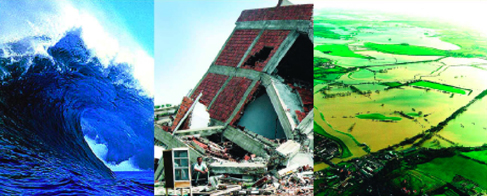
BACKGROUND: Pioneering tsunami research in U.S.A begun at the University of Hawaii following the devastating 1946 tsunami. Scientists at the Hawaii Institute of Geophysics, at the Pacific Tsunami Warning Center (PTWC), and at the International Tsunami Information Center (ITIC), in close cooperation with Institutions and scientists in other countries, contributed significantly over the years towards the development of tsunami research, to the initial improvements of the Tsunami Warning System in the Pacific, and later to tsumami preparedness around the world. Other prominent scientists from as far away as Alaska, other U.S. States, and countries in Europe, Asia, Australia, Oceania and Central and South America, joined in this effort.
The Tsunami Society was organized in 1982 at the University of Hawaii's Institute of Geophysics by Dr. George Pararas-Carayannis, the late Professor Dr. William Mansfield Adams and the late Professor Dr. Augustine S. Furumoto, as a professional Society and a focal organization promoting global research and supporting efforts to increase and disseminate knowledge about tsunamis and their hazards.
The name of the Society was changed in 2004 to Tsunami Society International (TSI), in view of the increased membership and contributions of scientists from around the world, and the increased global distribution of our award-winning journal: "SCIENCE OF TSUNAMI HAZARDS" (STH).
Presently, STH is a Certified, OPEN ACCESS Journal included in the prestigious international academic journal database DOAJ maintained by the University of Lund in Sweden with the support of the European Union. The STH Journal is also preserved and archived at the National Library, The Hague, Netherlands and at the U.S. Library of Congress, in Washington D.C., USA. Older issues are also archived at the US Los Alamos Laboratory Library in New Mexico, USA. Furthermore, the STH Journal is now included in EBSCO, ELSEVIER, SPRINGER, ResearcGate and other Publishing databases, which give the journal additional global exposure and readership in the databases of 90% of the academic institutions worldwide, including nation-wide access to databases in more than 70 countries.
In addition to the publication of four issues of the “Science of Tsunami Hazards” per year, TSI participates with DOAJ, the University of Lund in Sweden, the European Library at the Hague and European research libraries to help digitize all past articles in “SCIENCE OF TSUNAMI HAZARDS”, so they can be searchable online with the submission of metadata. We spend a great deal of time in this effort so that we can increase, even more, the visibility and usage of past and recent articles included in our Journal.
All past publications of the journal have been archived and we continue the processing and the systematic compressing of individual files to even smaller sizes to facilitate faster browsing and downloading. We are constantly optimizing our electronic database, improving the ranking of our website and registering the STH journal with prestigious databases for listing - so as to meet the increased, international scientific demands for tsunami data - which became significantly greater since the earthquake and tsunami disasters of 2004 Indonesia and other countries bordering the Indian Ocean, the 2010 Haiti earthquake and tsunami in the Caribean, the 2010 Maule earthquake in Southern Chile, the 2011 Tohoku tsunami in Japan, the 2012 in Western Canada, the 2013 earthquake in the Solomon Islands, the 2018 Palu-Sulawesi-Java-Sumatra-Indonesia tsunami, and the 2020 earthquake and tsunami in Samos-Greece and in Turkey..
Mandate and Mission of the Tsunami Society Intrnational
Tsunami Society International promotes the awareness and mitigation of tsunami hazards globally by sponsorship of workshops, meetings and symposia, and by disseminating knowledge about tsunamis to scientists, officials, the media and the public through the publication of its journal "Science of Tsunami Hazards", a home page, and other venues. Furtermore, Tsunami Society International provides a focus for discussion and interactions among its members, government agencies and the public. The primary objective is to mitigate the adverse impact of tsunamis on humanity.
Functions
Tsunami Society encourages collaborative and multidisciplinary research related to the tsunami hazards for the purpose of promoting education, training, public awareness and implementation of early warning systems that can save lives around the world and safeguard property. The Society, promotes the concept that tsunamis have a common adverse impact on mankind that transcends national boundaries and interests and, therefore, encourages regional and international cooperation for research, education and preparedness. More specifically - and particularly after the recent tragic tsunami disasters of the last two decades - the Society has greatly expanded its role and has held several international symposia and training programs around the world.
Additionally, Tsunami Soociety International promotes the setting up of facilities required for the undertaking of research on tsunamis, based on a holistic multidisciplinary approach that combines theoretical and applied sciences and mathematics, engineering, remote sensing methods, as well as social sciences, to the understanding of the tsunami phenomenon. The Society, further coordinates and promotes the mitigation of the adverse impact of tsunamis on humanity through the implementation and establishement of effective, early warning systems and through programs of education and preparedness;
Furthermore, a) the Society co-operates with other international scientific organizations, governments, foundations, industries, academic institutions and other professional groups concerned with the hazards of tsunamis; b) acts as a focal point in assisting coordination between research institutions and universities around the world - which promote programs of theoretical and applied tsunami research; c) Supports the organization of training programs, symposiums, workshops, seminars and other meetings to study topics of interest related to tsunami studies and preparedness; d) Conducts international Tsunami Symposiums; e)Assists governmental and private organizations with the establishment of appropriate liaison mechanisms.
In recent years the Society has held symposiums at the University of Hawaii campus, in Toronto Canada, in Ispra, Italy, at the Univeristy of Costa Rica and has been invited and has held seminars and training sessions in Ukraine, Malta, Hong Kong, Beijing, India, Saudi Arabia, Ecuador , Italy, Greece and many othe countries.
OFFICERS TSUNAMI SOCIETY INTERNATIONAL (TSI)
At the present time the officers are:
Dr. George Pararas-Carayannis, President
Dr. Carolyn Forbes, Secretary
THE JOURNAL SCIENCE OF TSUNAMI HAZARDS
The Journal of Tsunami Society Intenational, in support of its stated mission and functions, and in order to increase and disseminate knowledge about tsunamis and their hazards, has published continuously for the last 40 years the journal known as "SCIENCE OF TSUNAMI HAZARDS".
Although in recent years many tsunami research papers have been published in a variety of other miscellaneous journals, none of these journals are dedicated specifically to tsunamis. Searching for specific data and research results about tsunamis is often difficult and time consumming. Subscription costs are usually high, and thus many tsunami-related papers published in these journals have limited dissemination. Furthermore, the general public and scientists from developing countries, with limited institutional sponsorship and support, are often unable to subscribe or access these journals. However, Tsunami Society International makes all of its publications available readily to the international scientific community and to the general public free of charge.
Finally, to assure high quality standards of publication, all papers submitted to the Science of Tsunami Hazards Journal receive a thorough "peer-review" by an International Editorial Board consisting of senior scholars with specific multidisciplinary expertise. The archived published papers in the Society's journal include a wealth of data, research results and references on tsunamis that does not exist anywhere else.
SCIENCE OFTSUNAMI HAZARDS
The Journal of the International Tsunami Society
ISSN 8755-6839
Past issues of the journal are also available at a mirror site of the Los Alamos National Laboratory, http://epubs.lanl.gov/tsunami